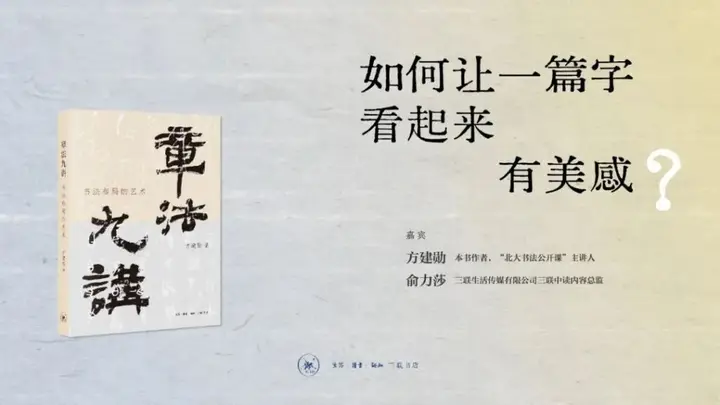
Why must calligraphy creation pay attention to composition? What are the unique characteristics of composition in different calligraphers' works? Are there common patterns among various compositions? How can one grasp the essence of composition? In the scorching heat, the Life·Reading·New Knowledge Trilogy Press has released a new book, "Nine Lectures on Composition," which starts from the origin and history of composition, sorting out a clear and straightforward logical path. Through specific and perceptible images and techniques, it delves into the underlying "logic"—such as yin and yang, transferring qi, and the middle way—which are precisely the unique aesthetic principles of Chinese culture.
Book cover of "Nine Lectures on Composition: The Art of Calligraphy Layout"
Recently, a book sharing session titled "How to Make a Piece of Calligraphy Look Beautiful?" was held at Beijing Sanlian Taofen Bookstore. The author of the book, Fang Jianxun, a researcher at the Center for Aesthetics and Aesthetic Education of Peking University, engaged in a conversation with Yu Lisha, the content director of Sanlian Life Media Company's Sanlian Zhongdu, and exchanged ideas with calligraphy enthusiasts both on-site and online.
Fang Jianxun, author. Life·Reading·New Knowledge Trilogy Press. Release Date: 2026-7
Fang Jianxun is a Ph.D. graduate from Peking University and a postdoctoral fellow in art history. He has been the host of the CCTV calligraphy channel "One Seal a Day" and主讲人 of "Peking University Calligraphy Open Course," whose online video播放量 has exceeded tens of millions of times. He has written books such as "Fifteen Lectures on Chinese Calligraphy," "Nine Lectures on Copying," "An Accessible Introduction to Chinese Calligraphy," "The Story of Running Script," and "Seal Realm."
From "Three Types of Compositions" to the Logic of Qi Transferral
In calligraphy, brushwork, character rules, and composition are considered the "three elements." The former two concern the beauty of individual characters, while composition determines the atmosphere and style of the entire work. At the sharing session, Fang Jianxun said that many enthusiasts can write beautiful single characters but still feel "wrong" when presenting them as a whole, and the root cause often lies in neglecting composition—this is also the direct motivation behind him writing "Nine Lectures on Composition."
In his book, Fang Jianxun summarizes the historical context of composition into three basic paradigms, known as "Three Types of Compositions": The first type, "Vertical rows, horizontal no columns," first appeared in the Shang Dynasty oracle bones, the Western Zhou bronze inscriptions, and the Han Dynasty bamboo slips. It is most commonly found in running script, with works like the "Preface to the Orchid Pavilion," the "Draft of a Eulogy for the Younger Brother," and the "Cold Food Observances" all belonging to this category. The second type, "Vertical rows, horizontal columns," is the most orderly. The "Taishan Stele" of the Qin Dynasty took this to its extreme, while Han Dynasty steles and Tang Dynasty regular script works such as Ouyang Xun's "Inscription of the Nine Pools Spring" and Yan Zhenqing's "Memorial Stele for Duobao" adopted it. The third type, "Vertical no rows, horizontal no columns," appeared the latest and is most commonly seen in狂草 (狂草) and some running cursive scripts. After the rise of Han Dynasty grass script, it gradually became mainstream. Wang Weizhen, Xu Wei, and Fu Shan pushed it to its peak.
Fang Jianxun at the launch event
Fang Jianxun emphasized that the three types of composition are like the "three major clans" that establish schools, and within each "clan," there can be infinite variations. For example, among the second type, the clerical script of Deng Shiru, Yang Yan, and Yi Bingshou of the Qing Dynasty had different treatments of intercharacter and interline spacing. He cited the example of Wei Stele calligraphy, which could be written in rows (with wider line spacing and tighter character spacing), and Wu Changshuo's 临 (copying) of the "Shigudu Stele," which gradually moved from neat alignment to writing in rows and even scattered and disordered arrangements, indicating that understanding the "logic" of composition allows for flexible application across the three types.
Fang Jianxun pointed out that regardless of which composition style is used, it must emphasize "qi transfer"—each row of characters has an invisible line of walking Qi, formed through the size, opening and closing, inclination, density, and brushstroke connections of characters. The core of achieving qi transfer lies in proficiency (brush technique proficiency, brush momentum connection, character momentum compliance), and he used the fact that inscriptions often have the most qi transfer as an example—since they are practiced thousands of times. He cited Wang Xianzhi's "Twelve Months Postscript" and "Separation Postscript" as typical examples of "one-brush writing"—the brush momentum seems to have not stopped from beginning to end, and it can also continue when switching to a new line—and suggested that those who feel their characters lack qi transfer should practice more. He also likened writing to "an improvised dance," where the brush is an extension of the body, and through writing, one allows the internal qi to flow, experiencing the joy of Liang Qichao's saying that "calligraphy is the simplest yet the happiest of things."
Yin-Yang Opposition, Using Empty Space as Black, and the Spirit of the Middle Way
When discussing the principles behind the rich and varied changes in composition, Fang Jianxun attributed them to "yin-yang opposition"—size, weight, length, expansion and contraction, round and square, density, connection and disconnection, thickness and thinness. These opposing relationships and their unity are the basic rules of composition changes, most easily seen in running and cursive scripts.
On-site event photo
At the event, Fang Jianxun displayed Wang Xizhi's "Letter to Two Xies" and "Preface to the Orchid Pavilion," along with Wang Duo's upright scroll. He said that Wang Duo brought out the best in yin-yang opposition, especially the middle scroll, "because of the richest and most natural changes," which had a great visual impact in the exhibition hall. However, changes must not be out of control. "Yin and yang are like a balance," Fang Jianxun explained, "ultimately, they must return to balance and coordination, which is the middle way." He quoted Wang Duo's self-description, "Change, and yet be moderate"—if change lacks the moderate and natural balance, it becomes odd. Using Wang Duo's 临 (copying) of Wang Xianzhi's "Boyang Postscript" as an example, he said that the left and right twists revolve around three vertical central lines, with every turn to the left matched by a turn to the right, ultimately returning to the balance of the central vertical lines—this demonstrates the "middle way within one piece."


